
 This life can be so mind-boggling, so utterly overwhelming, that language fails. In a sense, language will always be inadequate to express what we deeply feel and surprisingly discover. But today I’ll try to form a few thoughts about this wildly beautiful and at once deeply disturbing life that we live: mind-bogglingly glorious and also intensely pain-filled.
This past summer I once again visited the medieval city Steinau-an-der-Strasse in Hessen, Germany, famous for having been the childhood home of the Grimm brothers of fairytale renown. Whenever I’m there, I walk over to the centuries-old well built into the thick city wall, in modern times contained with pipes, the medieval stonework the same, its steps leading down to the pool, the very one where my mother, as a refugee in the aftermath of World War II, washed the family laundry. 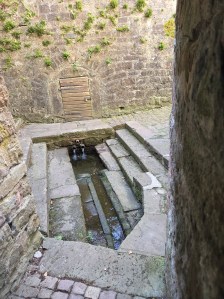 This double image of family history is extraordinary to me, the double image of trauma and peace: the picture of my mother kneeling here, cleansing clothing in this very spot, and decades later me standing here with my husband as the water continues to flow. Quiet marvels in a long story. The wonder of it all is that we get to be alive on what Madeleine L’Engle has called this “swiftly tilting planet.”
I marvel too when I consider how the Berlin Wall was built when I was a little girl, and how today I can hold a piece of that once formidable barrier in the palm of my hand.  When I pass around this rock to my university students, some gasp, “This is history! History!” and some ask, “What was the Berlin Wall?” It is amazing, is it not, that while many of us did not expect to see this wall gone in our lifetime, it went. Today I’m privileged to show this rock as an illustration that paradigms change. Just when we think some things are fixed, will continue indefinitely, they vanish. We ought to be careful, ought we not, as to how we navigate paradigms. The unbalancing through paradigm change, while often disturbing, can be healthy too. I’m reminded of walking on the unevenness of cobblestone paths.
Living as I do on Canada’s West Coast, the cobblestone streets of Europe enchant me. And they’re not the easiest things to walk on. The ancient stones are so well-worn that you can easily lose your footing, step awry into the gaps between stones, slip when you thought your stability was a sure thing. Walking these paths where many feet have travelled requires a certain wariness to maintain your balance. 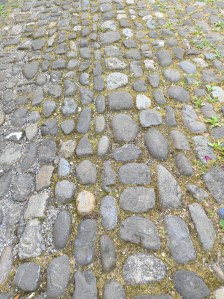 You’d be a fool to just march on as if you owned the road, as if the unaccustomed road would shape itself to your desires, as if the smoother pavement you’re used to walking on is everywhere. It isn’t. But wearing comfortable shoes while treading gingerly on old, cobbled paths helps in rebalancing. And in the rebalancing, it also awakens in me enchantment—the wonder that I am walking where people over the centuries have walked. I catch my breath, realizing anew that I have a small part in a long story. And this should give me great pause, to consider what their lives might have been like, to consider which paradigms they understood that have since shifted or even disappeared altogether, to listen to their words as best as I can. I’d be a fool to not care about what they can say to me.
A medieval well, a historic rock, cobblestone paths—these all astonish me, fill me with awe. These images sit somewhere alongside my perplexity over the frenzy of this world, in part owing to racing technological advances (oh sure, we like some of them). But today, especially as we are confronted with what we often call the growing normalization of hatred, my perplexity grows. It boggles the mind. With grief I consider, for example, how I went to school with the children of Holocaust survivors who began a new full life in Canada, and a few decades later with my Jewish friends I fear the rising anti-Semitism in our beautiful country and around the globe. This grief is compounded by the underlying idea that violence against people with whom you disagree on political and/or religious grounds and/or lifestyle choices is considered justifiable by the hate-filled. When words become bullets, bullets follow. And who is not guilty of having entertained cruel thoughts, spoken evil words? Some words can kill; others give life. Words can destroy or foster goodness. We get to choose which it’ll be: all day long we get to choose which kind of words we’ll speak, and it matters, it matters greatly.
In this mind-boggling life, where the simultaneous experiences of beauty and grief can feel like mental whiplash, I wonder how best to live. Whether our lives are perceived as long or short—and they’re all short in view of world history and especially in light of eternity—I wonder how to rebalance in order to be and do what I am called to be and do. When someone bursts out, “They killed him!”, and another says, “I got kicked in the gut!” time seems to have stopped in that split second, and the earth under me wobbles a bit more. How do my lungs begin to inhale hope again?
When a colleague asked me at the start of this autumn semester what I was hoping for, this picture came to me: I was hoping for a helium balloon in my spirit that would rise above the Oh no, look at. . . . As J.R.R. Tolkien wrote so tenderly to his son Michael during World War II, “There is a place called ‘heaven’ where the good here unfinished is completed; and where the stories unwritten, and the hopes unfulfilled, are continued. We may laugh together yet. . . .” 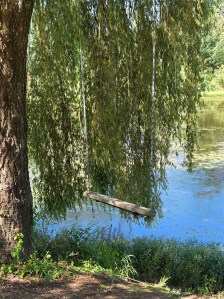 A small image of the helium hope came to me along a walkway around McMillan Lake on my campus, an old swing from a willow tree beckoning still. Also the words of Psalm 24 on this same pathway begin thus: “The earth is the LORD’s, and everything in it, the world, and all who live in it. . . .” Stopping to reflect on such things steadies me some. A few other recent experiences point to ultimate Joy.
When I consider that the newly conceived grandchild did not get to see the light of this world, and is now with the Lord Jesus, I experience peace beyond understanding which softens my layers of grief. Flowers from a dear friend remind me of what they say: the veil between this life and eternity is very thin. I believe it to be so.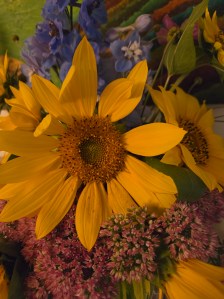
When friends can celebrate a book launch, as we did the other day for Stephen Dunning’s The Perilous Times Saga, rightness is restored to a significant measure in the midst of other things. (Recommendation: once you read Suzie and the Magic Turnip, you can hardly wait to read the next volumes.)
When I hear the music behind me on a neighbourhood walkway, and suddenly see the skateboarder zooming past, singing melodically, playing his guitar—such balance, such beauty, such fearlessness—I exalt. Am I dreaming? Am I awake?
When I recall the young girl at the beach this summer coming up from the flats of the low, low tide, cradling in her arms the shells she has collected, her face all aglow with a beautiful gentle smile over her treasure, I come awake again to the thrill of Splendour in this world.
So, in all things that gobsmack, outright boggle the mind, both through terrific evils and through the greater good all around, I canter along on my life’s path. Sometimes I slip, sometimes I fall, sometimes it’s all I can do to stand, but at all times I am held by the One who holds everything in his utterly capable hands. With Julian of Norwich, I speak her claim of the Great Hope: “All shall be well, and all shall be well, and all manner of thing shall be well.”
Thanks for reading, for listening.

You can order your copy of Letters to Annie at Amazon, FriesenPress, or through your local bookstore.
Sign up to receive my blogs at https://monikahilder.com/
Follow me on Social Media:
Watch for my December blog: “Reading the Last Chapter.”
 Monika Hilder