

Autumn is a special time to recall that we stand on tall shoulders. A walk through the woods among the giant trees, as I took the other day, can remind us that we have met with such. It’s breath-taking to behold the profusion of bright yellow foliage beneath the towering evergreens, evergreens like witnesses to our journeys, ever-present, it seems, watching, unmoved by commotion, their silence restorative, a speech, if it is speech, that might quiet your soul. I am listening.
And autumn is a special time in which I have the privilege to read and discuss much literature with my university students. We study great known literature and sometimes lesser-known literature that is also great. It’s exciting to experience how stories, some written very long ago, continue to speak today. So I am reminded of how the people who have gone before us have given us great gifts. Every single story contributes richly to who we are and to who we may become. None of us arrives at worthwhile thoughts and questions without having had the help of those who have gone before us. We are so much richer, so much stronger, and so much more appreciative of our membership in the human community through the many, many who have offered their gifts, their very selves, to partner with us on our own pilgrimages. I want to take a few moments to express my gratitude for some of the authors whose works I get to teach this season.
In my Fantasy Literature course, early September had us studying the Anglo-Saxon poem Beowulf. Written between the seventh and the tenth century, this heroic elegy not only gives us insight into that older world but the story has inspired many a writer to this day. If you know Tolkien’s work, for example, and then read Beowulf, you’ll recognize his inspiration. We read this poem in Seamus Heaney’s excellent translation, and the Old English text on the opposite page is a reminder of the world that continues to speak to us today. And then there’s Tolkien’s own translation to enjoy.
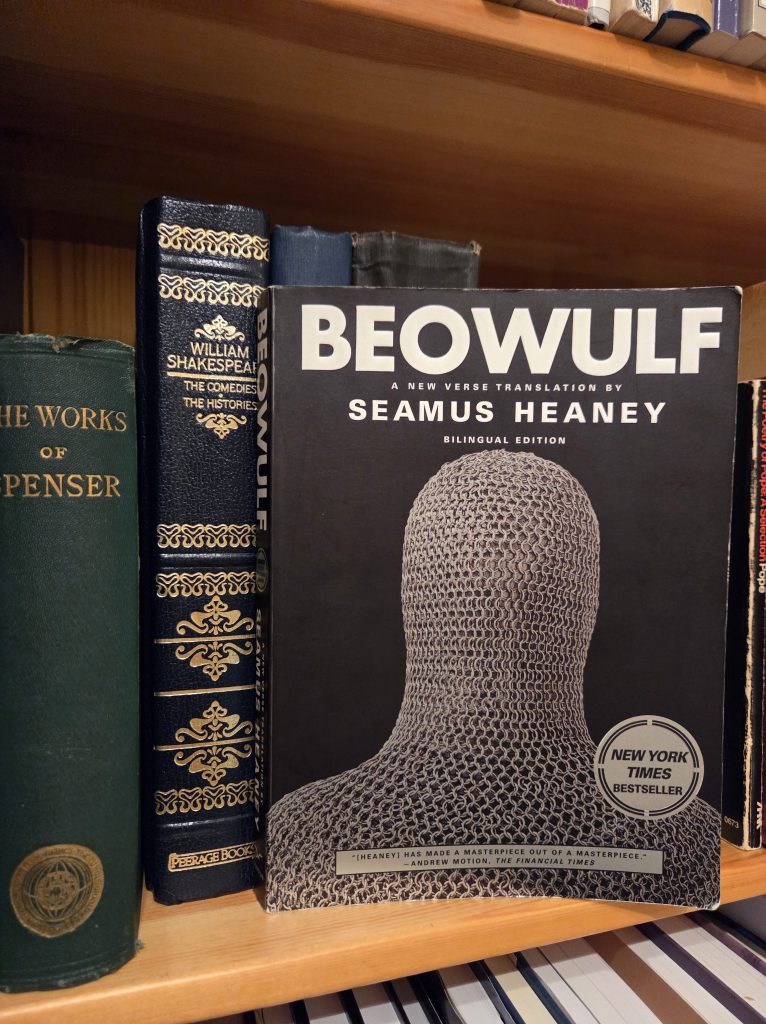
Listen to these opening lines of Beowulf in the original, which I always attempt to read to my students to give an auditory sense of how this stuff became part of the warp and woof of Tolkien’s psyche and artistry.
Hwæt wē Gār-Dena in geār-dagum
þēod-cyninga þrym gefrūnon,
hū ðā æþelingas ellen fremedon.
If you listen to recordings of more experienced readers of Beowulf and then turn to recordings of Tolkien reading from The Hobbit (there are no known recordings of his reading of Beowulf), you will find yourself transported to another era: to the world of hearth, heath, and hall, to the world of mighty warriors unafraid to face fierce danger, to dragons, to fellowship and feasting and legends unforgotten. C.S. Lewis referred to Anglo-Saxon literature as the “tap-root” of English literature. It is in every branch of this great tree, the origin of the very speech-rhythms that we use every day, and more, he claims, and insists that knowledge of our Anglo-Saxon origins should “never be abandoned.”
When we study Beowulf, we explore the nature of “northern heroic courage,” the kind of duty under fire that inspires the hero to defend the people, even to the point of death, even in the face of inevitable loss, ultimate worldly failure. We also explore the tension between pure pagan “Northernness” and the growing impact of the Christian faith. On the one hand, courage is inspired by the quest for personal glory; on the other hand, we are cautioned against arrogance and called to consider “The Almighty Judge . . . the Lord God,/ Head of the Heavens and High King of the World.” The tension between the Anglo-Saxon code and the Christian faith, the points which are reconcilable, and the points which are not, make for important thought on how we navigate conflicting ideas that we try to hold together, sometimes unknowingly.
Then September still has us delving into the Arthurian chivalric poem Sir Gawain and the Green Knight. One of my favourite phrases in the opening lines, in the original Middle English, which is so much easier for moderns to understand, is “blysse and blunder.” In this opening we’re given an overview of the mutability of life–bliss and blunder–or as Tolkien translated this phrase, “grief and gladness.” Civilizations rise and fall, rise and fall, and so what are we to make of King Arthur’s court, of the nature of its glory? And similar to Beowulf, how does the tension between this chivalric tradition and Christianity tell us something about human nature?
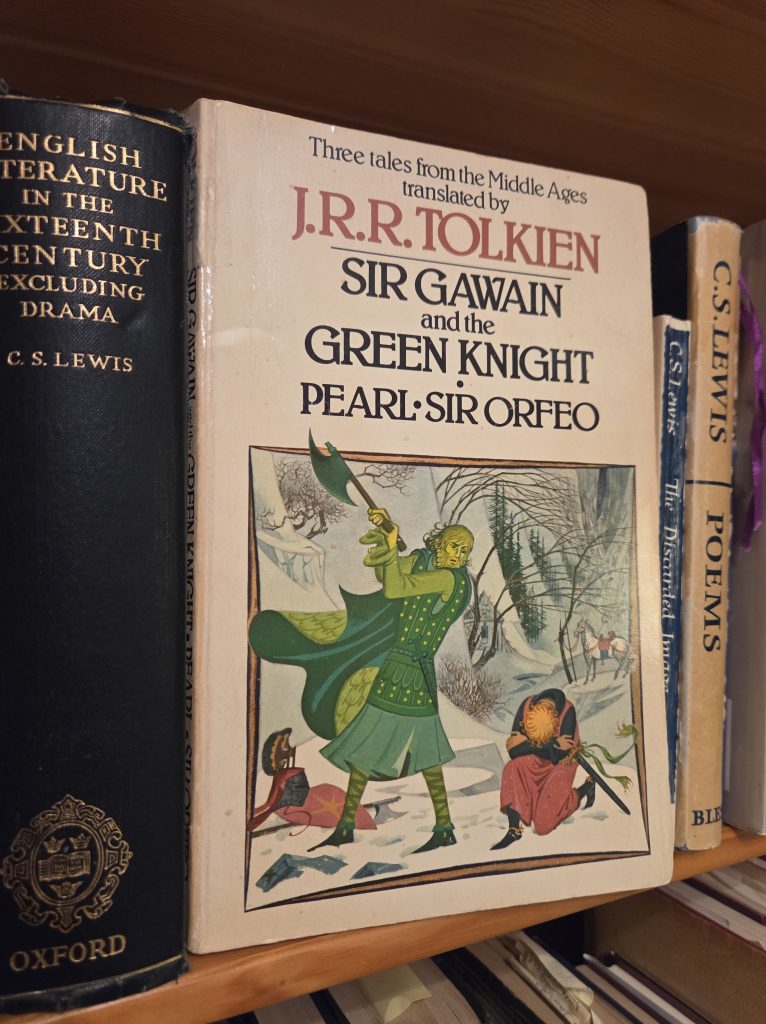
Moreover, in considering these two foundational traditions, the Anglo-Saxon and the chivalric forms of heroism, how do they potentially speak to us today? We wonder, is it possible to be both ferocious in battle and gentle in spirit? According to C.S. Lewis, the answer is, essentially, “Yes. And we must be so.” To understand his argument, I recommend reading his essay “The Necessity of Chivalry” in the collection of essays Present Concerns.
October will have us reading George MacDonald’s novel Phantastes, the book that C. S. Lewis said baptized his imagination so that he learned to love goodness. He returned from this experience of Joy to his ordinary life with the sense that it was yet the same but at once caught up into this brightness. One of the most memorable passages for me is this: “Joy cannot unfold the deepest truths, although deepest truth must be deepest joy. Cometh white-robed Sorrow, stooping and wan, and flingeth wide the doors she may not enter. Almost we linger with Sorrow for very love.”
Then we will delve into Lewis’s That Hideous Strength, a Tower of Babel thriller which follows the battle between an elitist group who wishes to remake humanity through technocracy and the faithful ones who choose organic life in harmony with nature. Who will win? Scientism, the amoral practice of the discipline of science, with post-humanity in view, or human society fighting against seemingly impossible odds? George Orwell had said that the scientist conspiracy Lewis portrayed here is “realisable.” And who will win? Of course we know who will win. What’s riveting is how the different players play their parts, and how the battle is won. This brief line always intrigues me: “the packed reality of Heaven.” If you’d like to know more about this “packed reality of Heaven” concept, see my article in Sehnsucht: The C.S. Lewis Journal
November will have us reading Tolkien’s The Fellowship of the Ring, where a beloved passage for many is the part when Frodo says that he wishes the dark time and the dire task before him had not happened in his time, and Gandalf answers soberly and also with visionary hope, “So do I, and so do all who live to see such times. But that is not for them to decide. All we have to decide is what to do with the time that is given us.”
And last but not least, we’ll turn our attention to Madeleine L’Engle’s Many Waters, her fantasy novel where teenage twins experience humanity at the time of Noah’s Flood. Again, how does the spiritual battle unfold? One favourite line for me is the seraph Alarid’s assertion, “Part of doing something is listening.”
I return to the claim that I began with: “I am listening.” When sunset arrives at the end of this autumn semester, I hope that I will have listened well, known more fully that I have had another marvellous opportunity to view the world and myself in it from the vantage of standing on very tall shoulders–wonderfully mighty sojourners whose wisdom is offered for the taking. May I receive the wealth with gratitude.

Thanks for reading, for listening.
You can order your copy of Letters to Annie at Amazon, FriesenPress, or through your local bookstore.
Sign up to receive my blogs at https://monikahilder.com/
Follow me on Social Media:
Watch for my December blog: “Dancing Shoes.”


Thank you, Monika, for your mail.
It reminds me of some of my lessons in German literature, when I often tried to make pupils get aware of lines of thought between some of our oldest Germnan literature, f.i. Hildebrandslied, Minnelieder, or Nibelungenlied. So many ideas expressed in the past could help us to understand our world and problems in a better way. And I regret that many old works of art seem to have vanished from our consciousness. And I greatly enjoy you wonderful use of your language.
Greetings from Reinulf Neumann
LikeLike
That Gandalf quote always gets me, though if I’m being honest, That Hideous Strength took me a couple of tries to get through. Lewis’s sci-fi can be a bit heavy, but your breakdown makes me want to pull it off the shelf again!
LikeLike